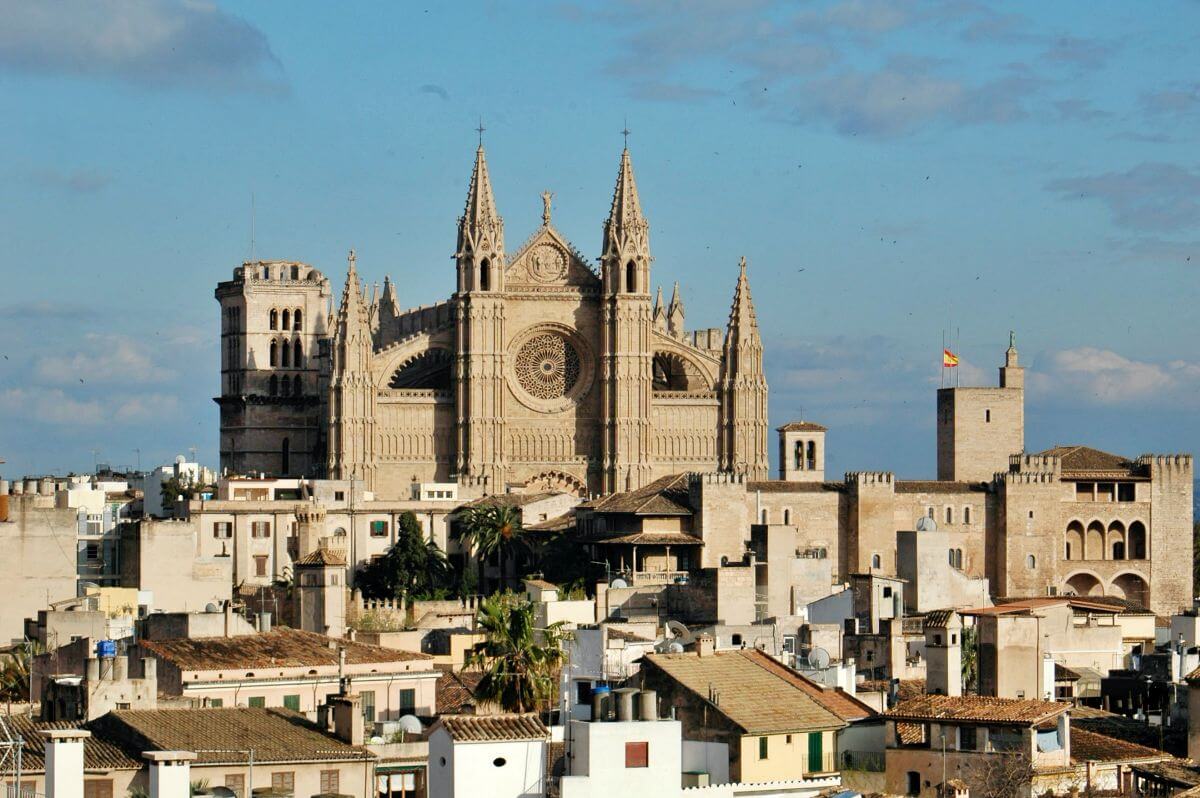
Some landmarks make a city instantly recognisable by their silhouette alone. Paris has the Eiffel Tower, London has Big Ben, and Palma undoubtedly has Palma Cathedral, known throughout Mallorca as La Seu.
Its impressive seafront façade makes it one of the island’s most recognisable sights and an essential stop for anyone visiting Mallorca. Yet stepping inside reveals that La Seu is much more than a spectacular Gothic cathedral: it is a journey through more than seven centuries of history, architecture, art and tradition.
Inside, you will find the work of two internationally renowned artists, Antoni Gaudí and Miquel Barceló, one of Europe’s most spectacular Gothic rose windows, a curious light phenomenon visible on just two dates each year, and rooftop terraces offering some of the finest views of Palma.
This guide brings together practical information for planning your visit, interesting details and tips based on our own experience, along with everything we think is worth knowing before entering one of the Mediterranean’s most iconic landmarks.
If you are planning a trip to the Balearic Islands, this landmark deserves a place on your itinerary.
At a glance
| Information | Details |
|---|---|
| Location | Plaça de la Seu, Palma |
| Recommended visit time | Between 1.5 and 2 hours |
| Accessibility | The interior is accessible with pushchairs and wheelchairs; the rooftop terraces are not |
| Rooftop terraces | Open from March to November |
| Photography | Allowed without flash |
| Audio guide | Available |
| Museum | Included in the admission ticket |
| Suitable for families | Yes |
Why visit Palma Cathedral?
It is one of those places that stays with you long after your trip is over.
Its construction began after the Christian conquest of Mallorca in 1229, when King Jaume I decided to build a great church dedicated to Saint Mary on the site of the former main mosque of Madina Mayurqa. His son, Jaume II, would give fresh impetus to the construction of a cathedral that took several centuries to acquire the appearance we recognise today.
This lengthy construction period explains why the building combines different artistic styles while retaining a harmonious overall appearance. Mediterranean Gothic predominates, alongside Renaissance elements and contemporary additions that greatly enrich the visit.
One of the most striking things when you enter is the sense of space and light. Natural light pours through the enormous stained-glass windows, creating a different atmosphere depending on the time of day.
It is easy to see why it is often called the Cathedral of Light.
But the feature that draws everyone’s attention is its enormous rose window, popularly known as the Gothic Eye. Measuring 11.38 metres in diameter, it is one of La Seu’s great symbols and plays a central role in one of Mallorca’s most famous light phenomena. Read on to discover more.
Antoni Gaudí’s legacy
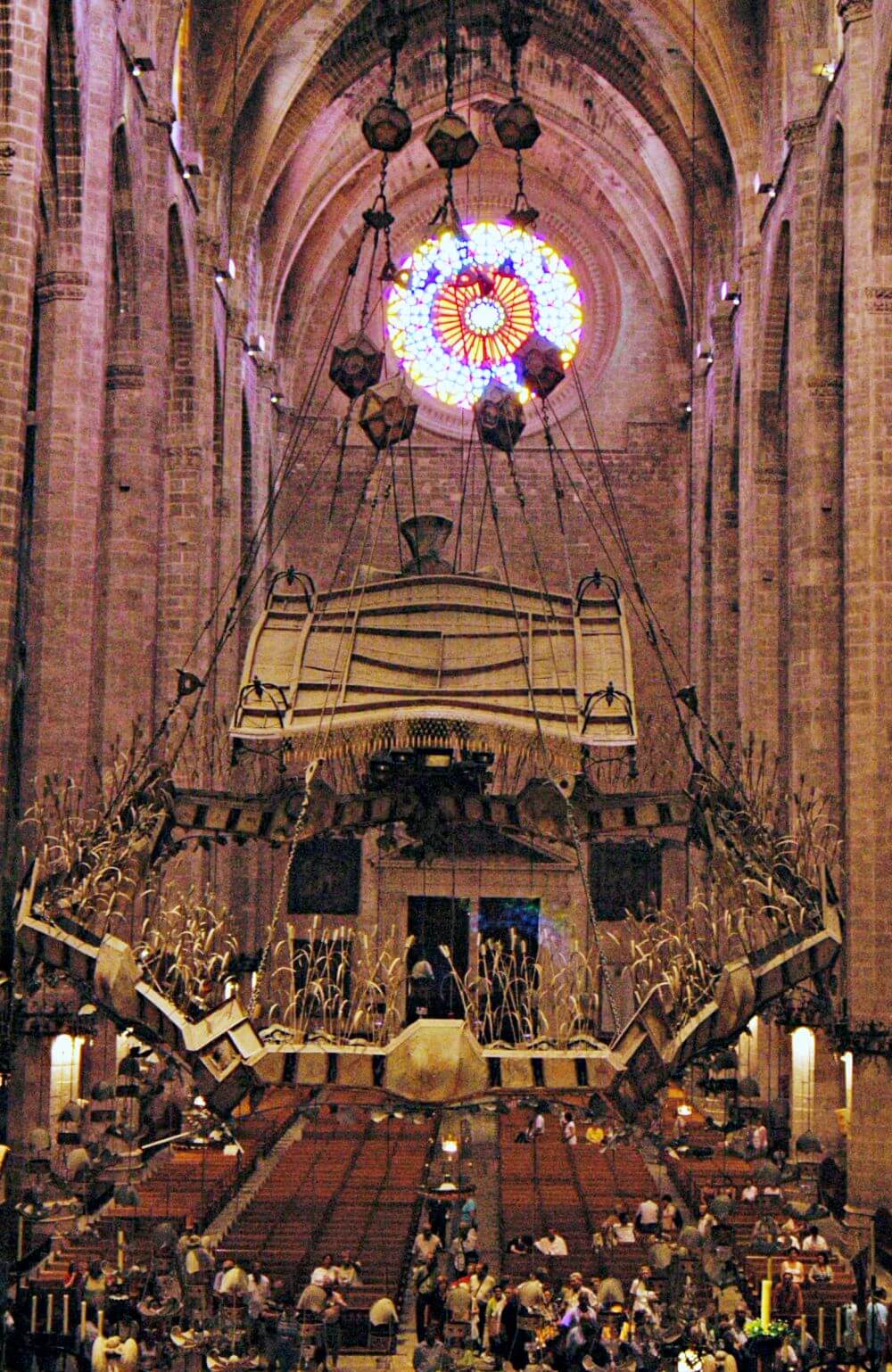
Although many visitors are unaware of it, Antoni Gaudí left a lasting mark on Palma Cathedral.
In 1904, he was invited to oversee a major renovation with a clear aim: to recover the essence of the Gothic space and enhance the light inside.
During his ten years working at La Seu, he completely reorganised the liturgical space, moved the choir and designed the spectacular canopy suspended above the high altar, one of the building’s most photographed features.
His plans were much more ambitious and included other changes that never came to fruition because of disagreements during the work. He eventually left the project in 1914, although his intervention had changed the Cathedral’s interior forever.
Today, it is impossible to explore the Cathedral without noticing the influence of this remarkable Catalan architect.
Miquel Barceló’s remarkable chapel
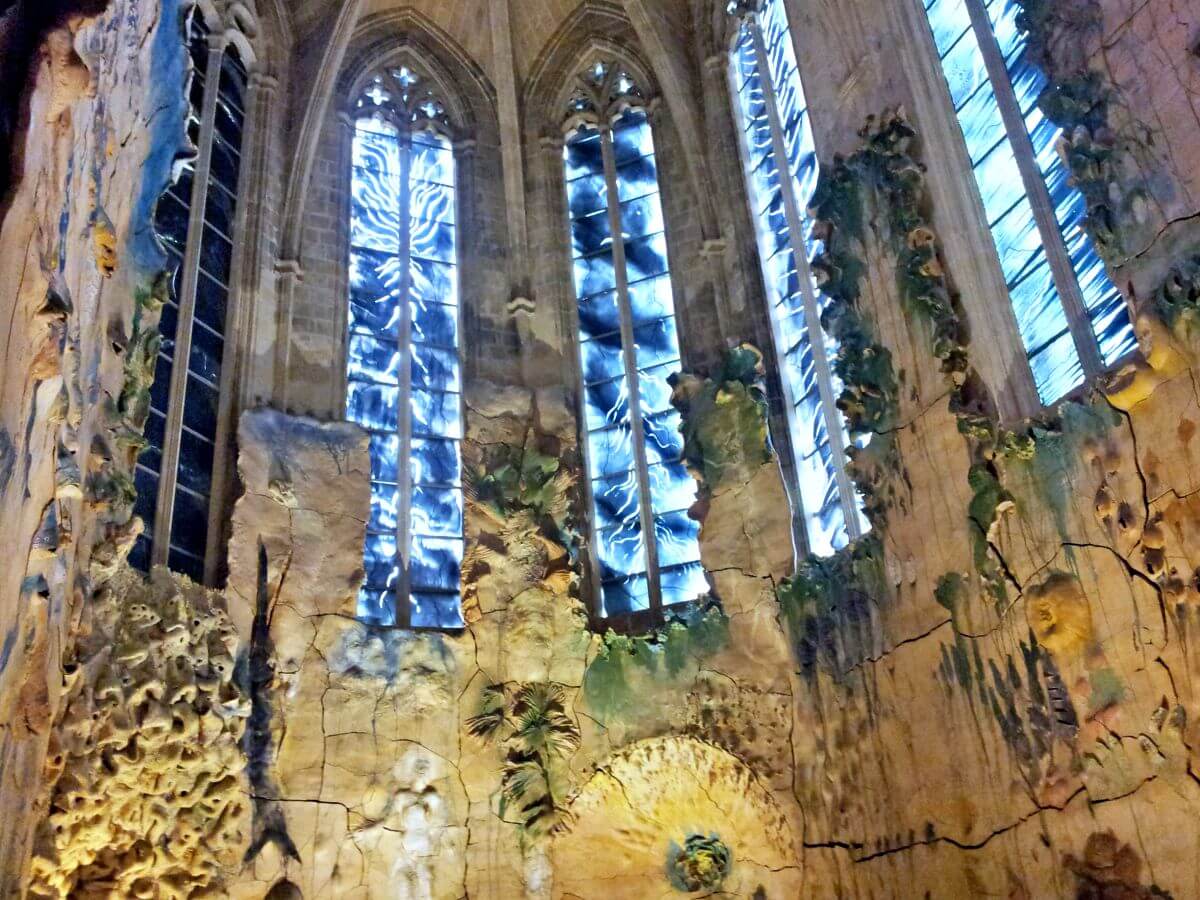
If Gaudí represents the Cathedral’s renewal in the 20th century, the Chapel of the Blessed Sacrament shows that it continues to evolve in the 21st.
Mallorcan artist Miquel Barceló completely transformed this space, which was inaugurated in 2007 after several years of work.
His spectacular ceramic mural depicts the miracle of the loaves and fishes through a marine world filled with fish, waves, textures and shapes that seem to emerge straight from the Mediterranean.
The work sparked considerable debate when it was unveiled. Over time, however, it has become one of the Cathedral’s main attractions and one of the most significant contemporary artworks created within a historic European church.
The Cathedral’s figure of eight: Mallorca’s famous light phenomenon
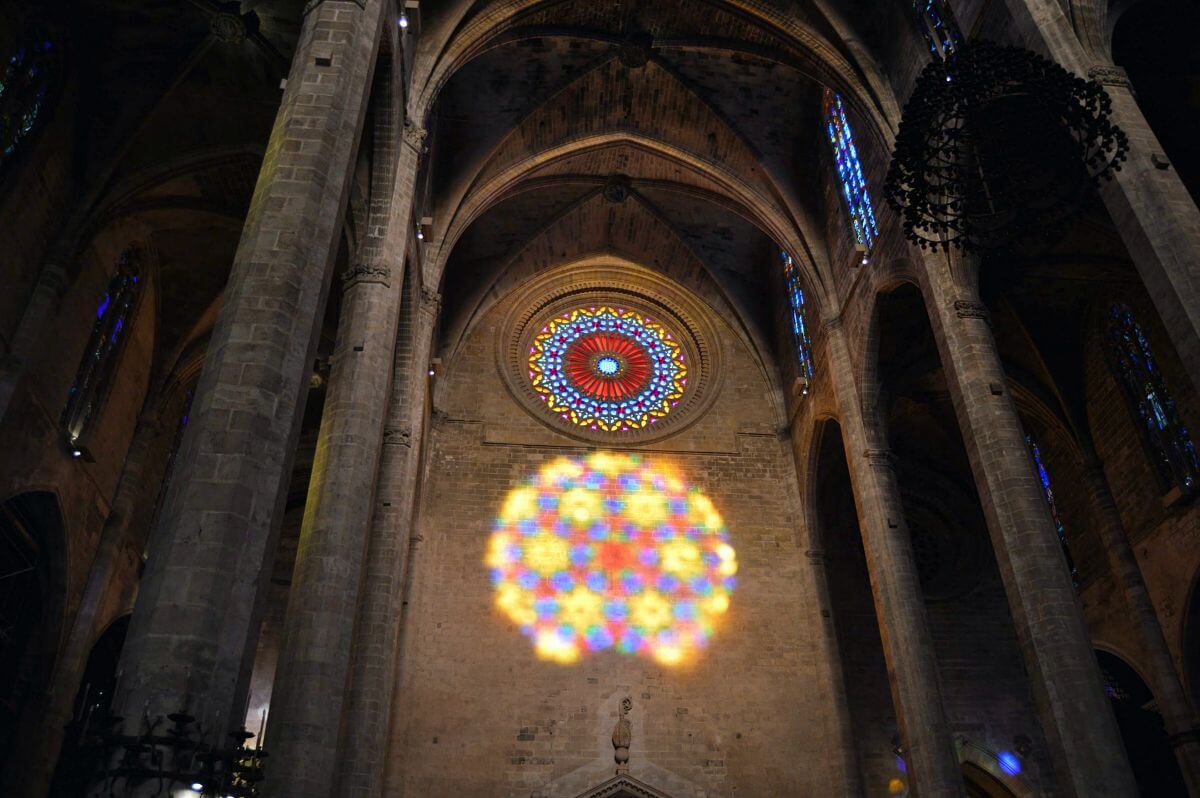
It happens on just two dates each year.
Every 2 February and 11 November, shortly after sunrise, sunlight passes through the large eastern rose window and projects a second image perfectly aligned beneath the western rose window.
For a few moments, the two circles form a huge, colourful figure of eight that seems to float inside the Cathedral.
Known as La Festa de la Llum, or the Festival of Light, this phenomenon attracts hundreds of photographers, curious visitors and architecture enthusiasts each year.
Although it lasts only a few minutes, it is one of Europe’s most surprising light spectacles and demonstrates the extraordinary mathematical and astronomical knowledge of the medieval master builders.
If you are lucky enough to be in Mallorca on either date, it is worth getting up early.
Palma Cathedral’s other major light phenomenon occurs around the winter solstice, close to 21 December. Unlike the famous figure of eight, this effect is best viewed from outside, particularly from elevated viewpoints such as the terraces of Es Baluard Museum of Contemporary Art.
Shortly after sunrise, the Cathedral’s orientation allows the first rays of sunlight to pass through both the main rose window and the rose window on the principal façade, creating a spectacular kaleidoscope of light and colour. This optical phenomenon is much less well known than the figure of eight, but is equally striking for anyone who has the opportunity to see it.
Visiting Palma Cathedral’s rooftop terraces
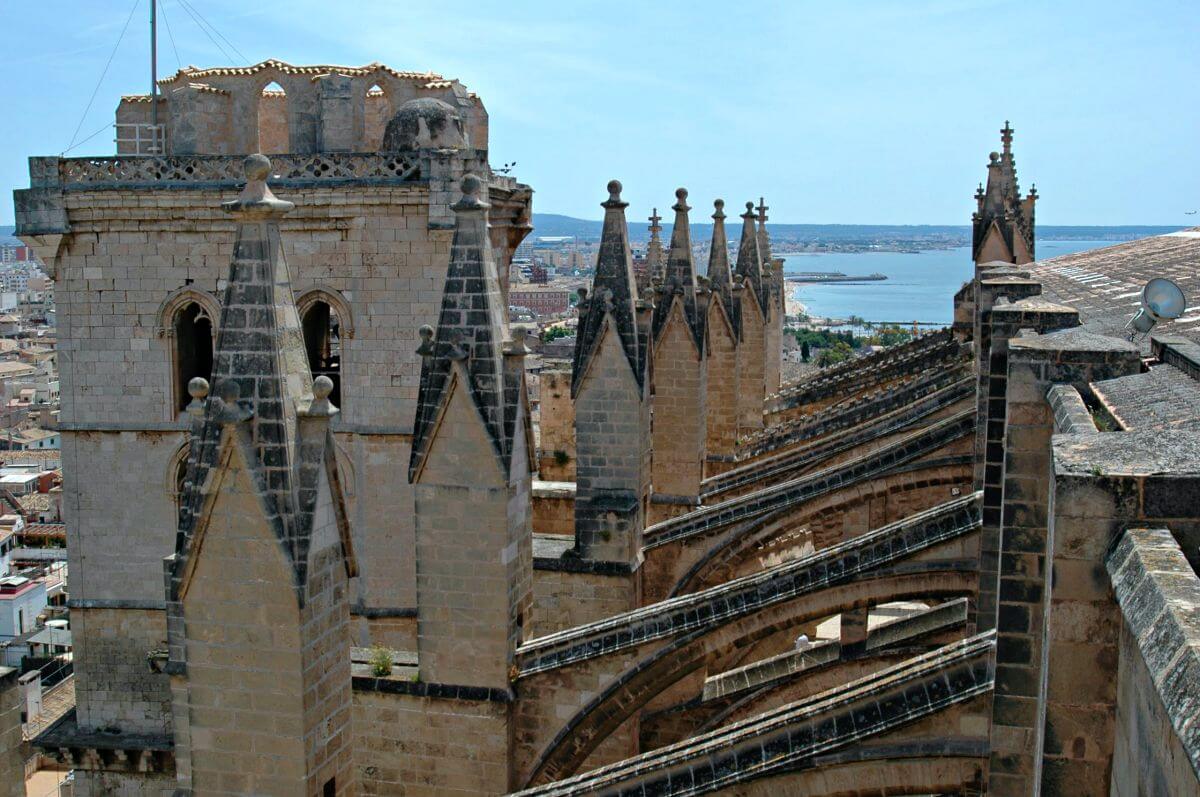
If you have already visited La Seu’s interior, or simply want to experience it from a different perspective, our recommendation is clear: head up to the rooftop terraces.
Few people realise just how spectacular it is to see the Cathedral from above.
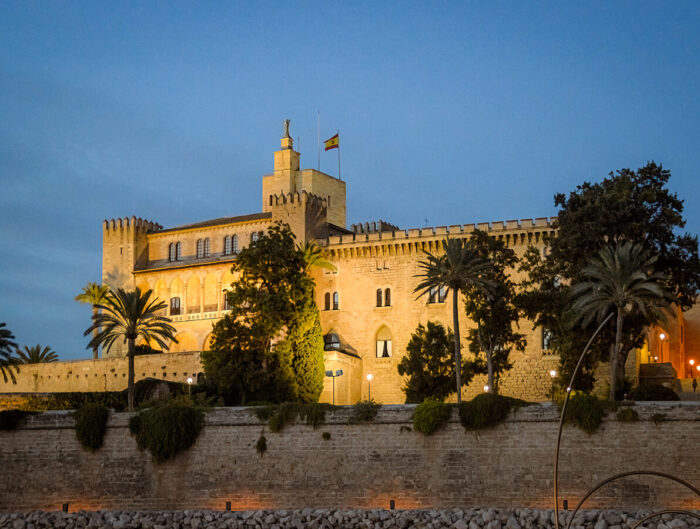
The route takes you between the great flying buttresses, lets you see the enormous rose window from outside and brings you close to the bell tower. Along the way, you can enjoy magnificent views of the old town, the Almudaina Palace, Parc de la Mar and the Bay of Palma.
It offers a completely different perspective on the building and is probably one of the most photogenic places in the city.
In our opinion, it is well worth the climb.
How to book tickets for Palma Cathedral’s rooftop terraces
You can book your rooftop visit through the Cathedral’s official website: Palma Cathedral.
Select a date to check availability. You will usually see several time slots showing the number of places remaining.
Once you have chosen a time, select your ticket type. If you qualify for the resident rate, choose that option before completing your purchase. A booking can include up to five people.
On arrival, show your ticket and, if you have booked the resident rate, proof of residency, such as your identity document or a residency certificate.
Rooftop opening times
The terraces are open from March to November, inclusive.
Monday to Friday
10:00–16:30
Saturdays
10:00–13:30
Visits start every thirty minutes and last approximately one hour.
Ticket prices
General admission: €25
Balearic Islands residents: €8
The ticket also includes admission to the Cathedral’s interior and the Museum of Sacred Art of Mallorca (MASM).
Can residents visit the rooftop terraces for free?
Yes. Residents and people originally from the Diocese of Mallorca can visit the rooftop terraces free of charge on Fridays.
To obtain a free ticket, go to the ticket office on the day you wish to visit and check which time slots are available. You will need documentary proof of your eligibility. Visits start every thirty minutes between 10:00 and 16:30, with a maximum capacity of 60 people per time slot.
Where to enter for the rooftop visit
Enter through the museum entrance in Plaça de la Seu. When you reach the square, it is at the far end, to the left of the Cathedral entrance. Inside, the meeting point for the rooftop visit is at the Portal de l’Almoina.
The doors open promptly at 10:00. When we visited, those with online bookings entered on the left, where staff checked our tickets and everyone’s identity documents for the resident rate.
Once inside, staff will show you where to go for the climb. On our visit, we went up in groups of around ten people, entering through one of the towers and climbing a spiral staircase with 137 steps. It is a demanding climb, but the views make it worthwhile.
What to know before booking
The visit is self-guided, with a maximum duration of 60 minutes. This is plenty of time to see the distinctive flying buttresses, the spectacular main rose window, the stained-glass windows from outside, the bell tower and, above all, the beautiful views over the city skyline.
The route is not suitable for people with vertigo, claustrophobia, cardiorespiratory conditions or reduced mobility.
Access is restricted to visitors over 9 years old. Visitors under 18 must provide an official identity document showing their age and be accompanied by at least one adult per child.
Visiting Palma Cathedral with children
At first glance, this might seem like a visit mainly for adults, but our experience has been quite the opposite.
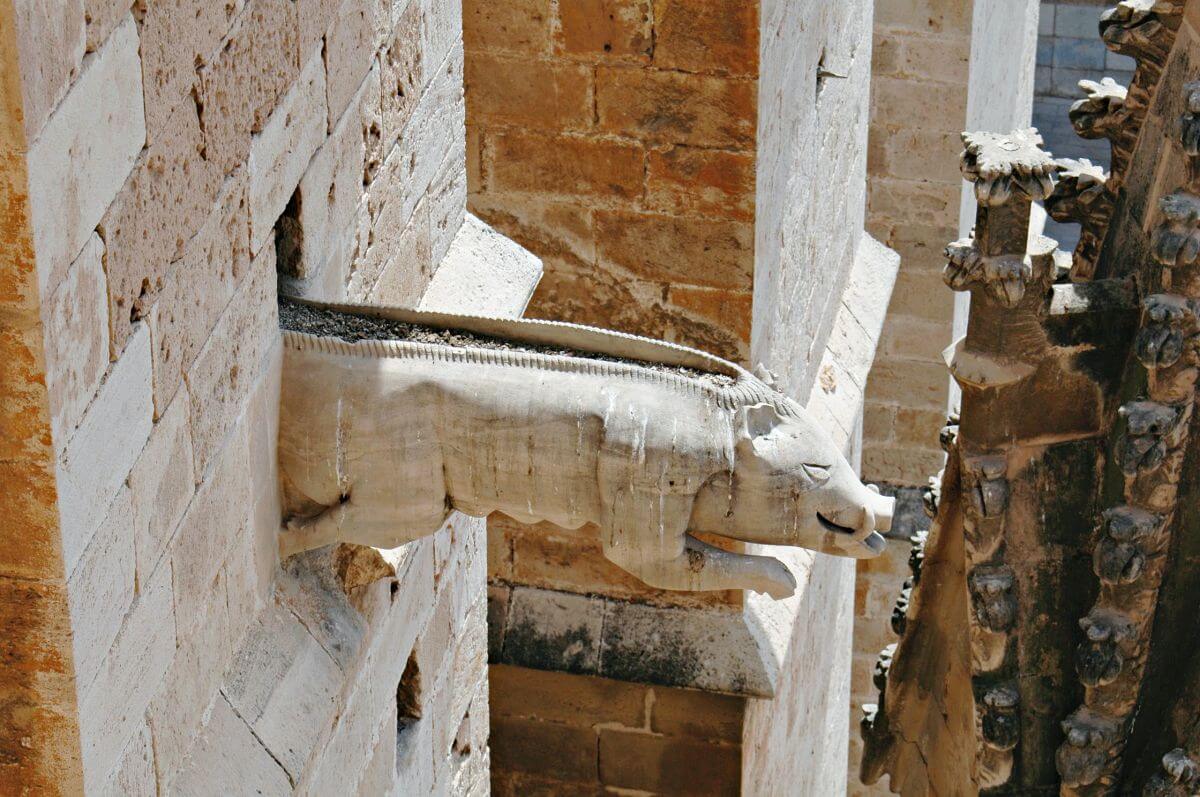
The enormous columns, colourful stained-glass windows, outdoor gargoyles, huge rose window and Miquel Barceló’s remarkable chapel usually spark children’s curiosity straight away.
The interior is also accessible with a pushchair, making it a comfortable visit for families with young children.
If you are visiting with very young children, a good idea is to combine the Cathedral with a stroll through Parc de la Mar, directly in front of it. There is space for them to run around and take a break before or after the visit, and you can discover the story of the crocodile said to live in its waters.
Our tips
Having visited on many occasions, these are some of the tips we think will help you make the most of La Seu:
- Allow at least an hour and a half to explore the interior at a relaxed pace. If you are also visiting the rooftop terraces, allow around two hours in total.
- Visit first thing in the morning whenever possible. There tend to be fewer visitors, and the light inside can be particularly beautiful.
- If you are a Balearic Islands resident, take advantage of the free rooftop visits on Fridays, but arrive early as places often fill up.
- Do not miss Miquel Barceló’s chapel. Even if contemporary art is not usually your thing, it deserves a few minutes of your attention.
- Bring water if you visit the rooftop terraces in summer, as much of the route is outdoors.
- For a beautiful exterior photograph, head to Parc de la Mar, particularly towards sunset when the stone takes on warm golden tones.
- If you have time after your visit, explore Palma’s old town. The Almudaina Palace, Arab Baths and La Calatrava neighbourhood are all a short walk away.
Frequently asked questions about Palma Cathedral
How much does it cost to visit Palma Cathedral?
Several ticket options are available. The rooftop visit costs €25 for general admission and €8 for Balearic Islands residents. Eligible residents can visit the terraces free of charge on Fridays.
What does the rooftop ticket include?
It includes access to the rooftop terraces, the Cathedral and the Museum of Sacred Art of Mallorca (MASM).
Which day is free for residents?
Residents and people originally from the Diocese of Mallorca can visit the rooftop terraces free of charge on Fridays. Tickets must be collected from the ticket office, and documentary proof of eligibility is required.
How long does the full visit take?
A full visit usually takes between an hour and a half and two hours.
When is the best time to visit?
Spring and autumn generally bring fewer visitors and more comfortable temperatures. If you are visiting Mallorca in winter, consider planning your trip around the Cathedral’s figure-of-eight light phenomenon on 2 February.
Is it worth visiting with children?
Yes. The stained-glass windows, gargoyles and sheer scale of the building usually capture children’s attention.
You might also like