Deià, sometimes written as Deyà, is one of those Mallorcan villages worth exploring on foot. It lies in the Serra de Tramuntana, between the sea and the mountains, and borders Valldemossa, Sóller and Bunyola.
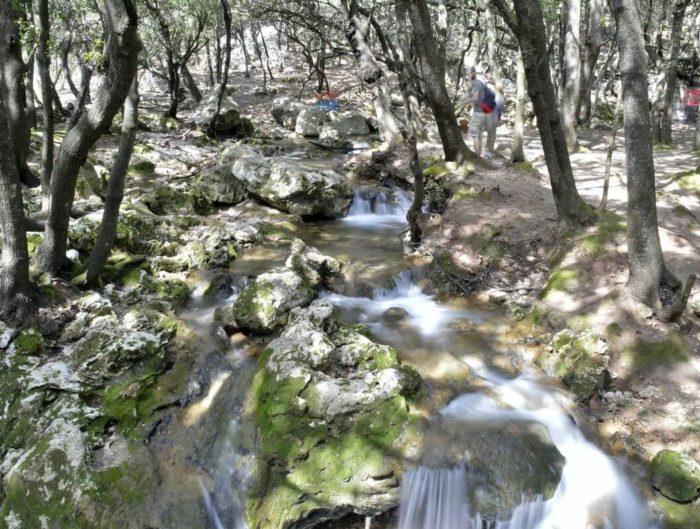
Water is part of the village’s character, especially in winter and after rain. The torrent des Racó runs beside village streets and paths before joining the torrent Major, which carries the water down to Cala Deià.
The stone houses, terraces and narrow lanes still give Deià much of its character. They also help explain why UNESCO added the Cultural Landscape of the Serra de Tramuntana to the World Heritage List. Water and dry-stone walls have shaped this landscape for centuries. According to the village’s official history, the hillsides were already farmed in terraces in the Islamic period.
On a first visit, we’d walk up to the church and cemetery and then down to es Clot. From there, you can choose between the short es Racó loop and the circular walk to the cove.
What to see in Deià
Sant Joan Baptista church and the cannon viewpoint
One of the loveliest walks in the village is the climb to Sant Joan Baptista, the parish church of St John the Baptist. If you’re driving, leave the car in one of the signposted car parks and walk up via carrer des Puig. The hill is part of the walk.
The church has a single nave with a square plan and a barrel vault. Beside it stands the bell tower, which once served as a lookout and helped defend the village.
In front of the church are the two cannons that give the viewpoint its name and a monument to American archaeologist William Waldren. During excavations at cova de Muleta he found numerous remains of Myotragus balearicus, an extinct bovid that lived on Mallorca and Menorca until several thousand years ago. Palaeontologist Dorothea Bate had described the species in 1909. You can see a reconstruction of its skeleton at the Balearic Museum of Natural Sciences in Sóller (our guide is in Spanish).
From the viewpoint, look for the outline of Puig des Teix rising above the village.

The cemetery and Robert Graves’s house
The village cemetery is behind the church. Up here, the views open out towards the mountains and the sea. This is where British writer and poet Robert Graves is buried.
Graves arrived in Deià in 1929 with the poet Laura Riding. He left Mallorca in 1936 and returned in 1946 with Beryl and his family. He died in Deià in 1985. You can visit his house, Ca n’Alluny, which still has furniture and objects from his time there, and walk around the garden. Check opening times on the Robert Graves house museum website. Among his best-known books is I, Claudius, which the BBC adapted in the 1970s.
Refugi Can Boi

In the es Clot neighbourhood, beside the torrent Major, you’ll find Refugi Can Boi. It’s part of the Serra de Tramuntana mountain hut network and the GR 221 Dry Stone Route. If you’d like to stay overnight, check availability and conditions on the Consell de Mallorca’s refuge page.
If you get the chance, look inside the refuge’s old tafona, or olive mill. It still has its mill, beam press, forge and grain stores. After seeing the olive groves around Deià, it’s a good way to understand how people made oil in these houses.
Circular walk to Cala Deià

The circular walk to Cala Deià starts at the refuge. We cover it step by step in a separate guide. It’s a fairly short walk, with a climb on the way back. After rain, you can see the torrent Major flowing towards the cove.
Cala Deià has a beach of pebbles and coarse sand. To one side are the escars, fishermen’s boathouses with ramps for hauling boats out of the water and space to store their gear. If the restaurants at the cove are open, you can stop for a meal by the sea. The cove gets busier in high season, so if you’re visiting both places it’s practical to leave the car in the village and walk down.
The Camí des Racó circular walk
This short loop along the camí des Racó is a good way to see the water that flows through Deià in winter. The walk is particularly rewarding after rain.
Start at the public washhouses beside the main road. A cobbled path climbs to their left. When the torrent des Racó is flowing, you can see the cascade beside the path.
Follow the stream uphill to a small bridge. Cross it and take the tarmac lane on the left, now heading downhill. From here you get a different view of the village, with the green hillside between the stone houses.
Further down, a stone path climbs on your right. Look for the plaque marked Camí de Can Fussimany.
This path takes you back to the main road. Head down to the washhouses again. Directly opposite them are steps with another view of the stream. Keep going downhill to reach es Clot and Can Boi refuge, where you can continue towards Cala Deià.
Approximate duration: up to 40 minutes, depending on how often you stop. The walk suits children who are used to walking. It has hills, cobbles and steps, so it’s unsuitable for pushchairs. The cobbles can be slippery when wet.
How to get to Deià and plan your visit
The Ma-10 runs through Deià, connecting the village with Valldemossa and Sóller. If you’d rather go by bus, TIB route 203 stops in the village. Check the stops, departure times and any seat reservation options with TIB before you travel.
If you’re driving, use the signposted car parks and look out for spaces reserved for residents. Parking at the cove is limited, and the council can restrict vehicle access when it fills up. Expect hills and steps around the village, especially on the way up to the church.
What to see near Deià
Between Deià and Valldemossa, you can stop at Son Marroig, once the estate of Archduke Ludwig Salvator. From the marble pavilion you can see the sa Foradada peninsula. If you’d like to walk down to it, we explain the route in our sa Foradada walking guide.
You might also like