

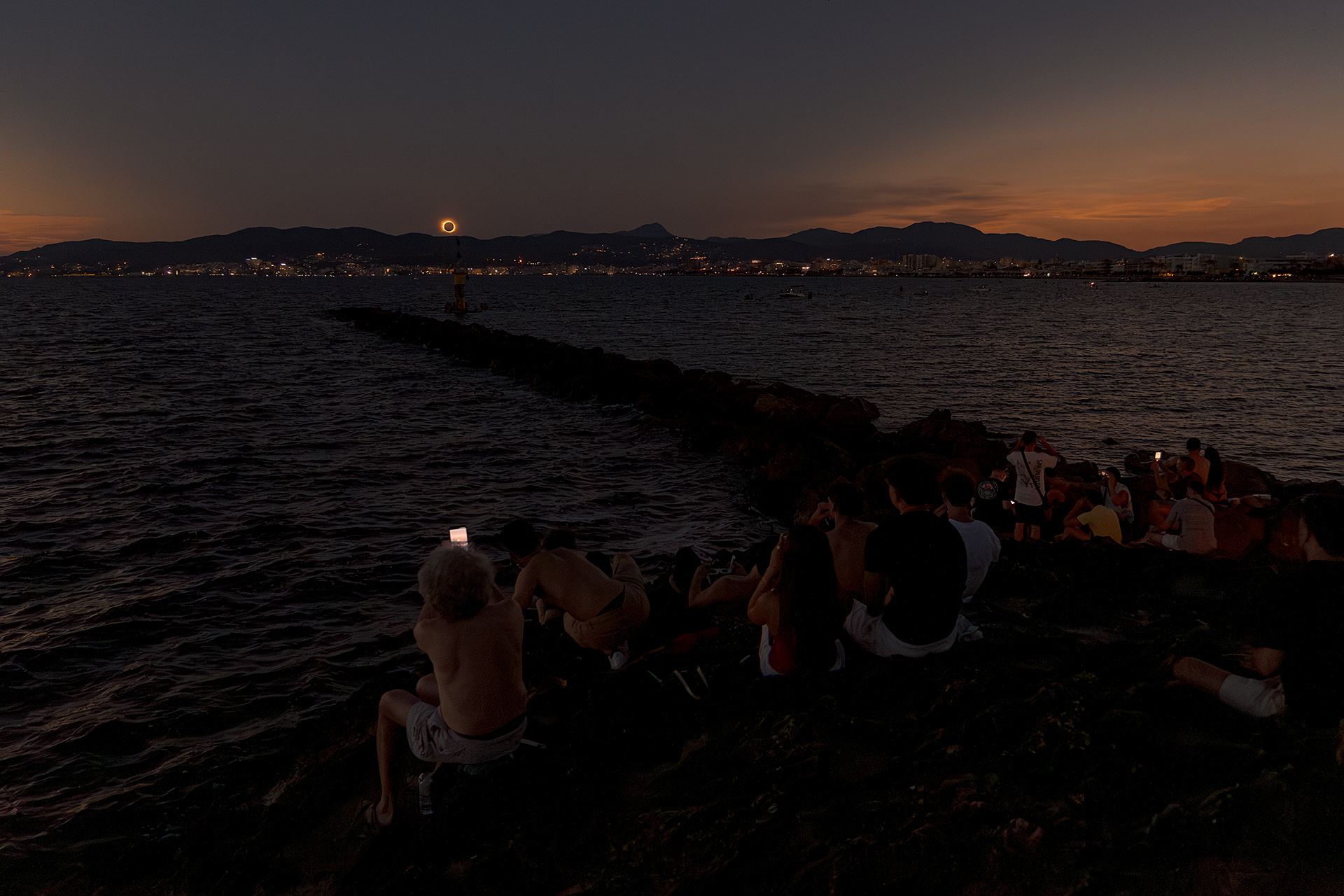
After the total eclipse of 12 August 2026, there are two more dates to look forward to in Mallorca. On 2 August 2027 we’ll see a partial solar eclipse in the morning. On 26 January 2028, an annular solar eclipse will bring the ‘ring of fire’ close to the horizon. Here’s when to look, how to choose a spot and what to bring to watch safely.
Upcoming solar eclipses in Mallorca
| Date | What you’ll see in Mallorca | When to look |
|---|---|---|
| Monday, 2 August 2027 | Partial solar eclipse | In the morning. The eclipse peaks at about 11 am. |
| Wednesday, 26 January 2028 | Annular solar eclipse, the ring of fire | Near sunset. The eclipse peaks at about 5:57 pm. |
All times are local to Mallorca. Below we compare a few places around the island to help you decide where to watch.
The 2 August 2027 solar eclipse in Mallorca
The 2 August 2027 eclipse will be partial across Mallorca. The Moon will cover much of the Sun, leaving a bright crescent. The path of totality crosses the southern tip of mainland Spain and the Strait of Gibraltar. Here in Mallorca, it will stay light.
Expect it to start at about 9:50 am, peak around 11 am and finish between 12:13 and 12:15 pm, depending on where you are. It peaks around 10:59 am in Estellencs, Palma and Felanitx, and around 11 am in Capdepera. Look east-southeast. The Sun will be fairly high, so an open space near where you’re staying should do. Look up your town in the IGN’s 2027 timetable.
The 26 January 2028 annular solar eclipse in Mallorca
On 26 January 2028 the Moon will leave a bright rim around the Sun, the famous ring of fire. The partial phase starts at about 4:41 pm. The ring starts to form around 5:55 pm and the eclipse peaks around 5:57 pm. In Mallorca the Sun will be almost on the horizon, so where you stand makes a real difference to how long you’ll see it before it disappears.
Where to look for a clear horizon in 2028
The table shows the IGN’s calculated sunset times for each town. A ridge, a building or even a line of trees can hide the Sun earlier from the exact spot where you’re standing.
| Location | Approx. sunset | What that means for seeing the ring |
|---|---|---|
| Andratx · southwest | 6:02 pm | You could see the entire ring phase with a clear view. |
| Palma · bay | 6:01 pm | There’s time on paper, but the terrain may hide the Sun earlier. |
| Pollença · north | 5:59 pm | Sunset cuts the ring phase short at the town’s reference point. |
| Capdepera · east | 5:58 pm | The Sun sets shortly after maximum eclipse, leaving very little time. |
Look for a clear horizon to the west-southwest (about 245–246° on a compass). The southwest coast is a good place to start. Colònia de Sant Jordi and the Miramar viewpoint also come up in the TresEclipses visibility simulations. These are estimates based on the terrain. We’d go beforehand in the late afternoon and see what the view looks like from the exact spot. Es Carnatge worked for us in August 2026, but in January 2028 the Sun will set in a different direction.
To compare locations, see the IGN’s official 2028 timetable or find your spot in its eclipse map. Our guide to Mallorca sunset spots (in Spanish) may also give you a few places to explore.
How to watch a solar eclipse safely
In Mallorca, you’ll need eye protection throughout both the 2027 and 2028 eclipses, including the ring of fire. For direct viewing, use intact eclipse glasses or a solar viewer from a reputable supplier that meets the ISO 12312-2 standard. Ordinary sunglasses offer inadequate protection. Keep your protection on even if the Sun is low or behind clouds.
Binoculars, telescopes and cameras need a purpose-made solar filter firmly attached to the front of the lens. Eclipse glasses are for looking with your eyes alone. Never use them to look through an instrument without its own filter. For an activity with children, try projecting the Sun through a small hole in a piece of card. Stand with your back to the Sun and look at the projection. See NASA’s eclipse safety guide for more details.
Watching with children
We like to explain what’s going to happen beforehand and bring a pair of glasses for everyone. Help younger children put theirs on and supervise them while they watch. Pick somewhere with room to wait, bring water and a hat in August and a warm layer for sunset in January. If cloud rolls in, a nearby backup spot is more practical than crossing the island at the last minute.
How to photograph the eclipse with a camera or phone
A tripod and a composition planned in advance give you more time to enjoy it. A telephoto lens of 200 mm or more will make the Sun the subject. A 24–70 mm or 24–105 mm lens works well if you want to include the landscape, especially in January. If the Sun is in the frame, fit a suitable solar filter before pointing the camera at it and keep the filter on throughout the eclipse.
With a camera, try starting at RAW, ISO 100 and f/8, then adjust your exposure after a test shot. Use manual focus and a timer or remote release. Shutter speed depends on the light and the filter. With a phone, fit a solar filter designed for its camera, clean the lens and try the optical zoom if available. If you’d rather capture what it felt like to be there, film the atmosphere and the people around you with the camera facing away from the Sun.
How Mallorca saw the total eclipse of 12 August 2026
It was the first of the three eclipses. The path of totality crossed Mallorca at sunset, and in places such as Platja de Palma the Moon completely covered the Sun for about a minute and a half. Cloud obscured the view in some parts of the Tramuntana. The eclipse also coincided with the peak nights of the Perseid meteor shower. The Balearic government’s eclipse page has footage from the day.
How we saw it
On 12 August we went as a family to the far end of the Molinar seafront. We sat on the rocks in front of the El Peñón restaurant. There were crowds of people, but we found a comfortable spot with the Serra de Tramuntana across the bay.
We’d been hearing about the eclipse for a long time. When the Sun went dark and we saw the light change over the mountains, we were awestruck. Between what was happening in the sky and the sheer number of people who’d gathered along the seafront, it was more than we’d imagined. That’s what we tried to capture in the photos you’ll see in this guide.
We’re looking forward to the next two eclipses. Each will have something special about it, though neither will bring the same darkness to Mallorca as that total eclipse did. We’ll always remember that evening on the Bay of Palma.

Our guide that summer covered viewpoints and stretches of coast including Sa Foradada, Torre des Verger, the Cap Gros lighthouse, Cap Blanc and Cap de Regana, Colònia de Sant Jordi, Cap de ses Salines and Platja de Palma. There were nine official viewing areas in Mallorca that day, including Platja de Palma and Santa Ponça, and access was controlled in parts of the Tramuntana, Formentor and the south. For upcoming eclipses, check notices from the Balearic government and local councils, the IGN calendar and any events announced by FIAAM, Mallorca’s astronomy and astronautics foundation.
If you’re planning a trip to Mallorca
For August 2027, staying somewhere within walking distance of an open space saves you a journey on the morning of the eclipse. For January 2028, it’s worth picking the area where you’d like to try to see the ring and checking the horizon first. Depending on how you travel, see our guides to family-friendly places to stay (in Spanish), campervan and motorhome stopovers, mountain huts and budget accommodation and camping in Mallorca.
You might also like


