Some villages in Mallorca are well worth seeking out on a first visit. For those of us who live on the island, they’re also places we like to return to. It only takes a turn into a cobbled lane to feel as though we’ve stepped back in time. Many of these villages get busy, and it’s easy to see why, but even on a crowded day we can leave the bustle of the city behind, slip away from the square and spend a while walking among the stone houses.
In the Serra de Tramuntana, many of these villages also mark the start or finish of a walk. Sometimes we arrive with our walking boots on, ready to set off. Other times we’re coming back and all we want is a seat on a terrace. Fornalutx suits both.
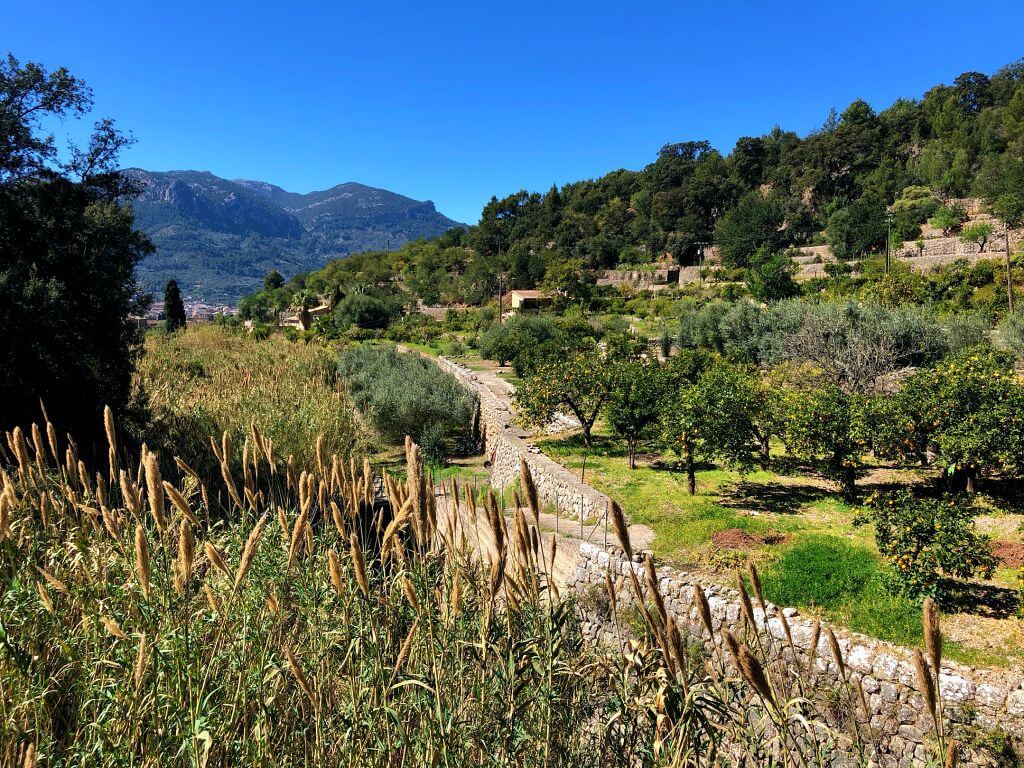
Fornalutx is one of those villages in the Serra de Tramuntana where we like to turn up without much of a plan. We might start with a drink in the square and end up wandering between stone houses, with the orange and lemon terraces of the Sóller valley in the background. If you fancy a longer walk, the Camí de Binibassí leads from the village to Sóller.
A stroll through Fornalutx
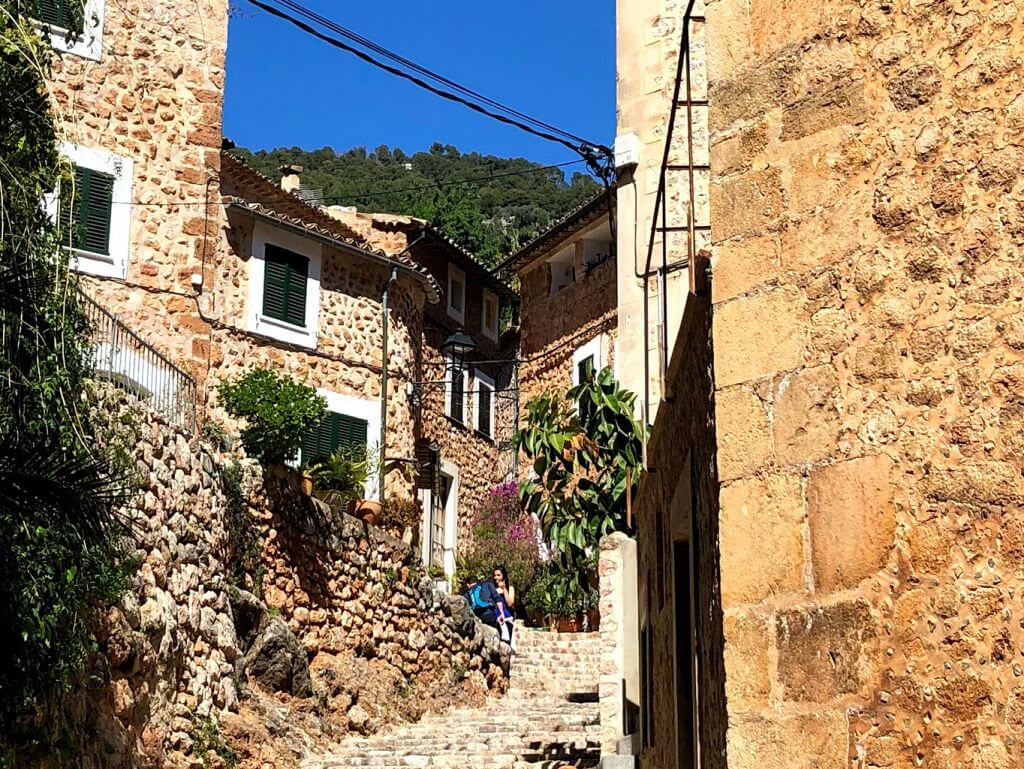
We’d start in Plaça d’Espanya, home to the Church of the Nativity of Mary and a few café terraces. From there, we can head up the cobbled streets to Ca n’Arbona, the former town hall, which still has its 17th-century defensive tower. To extend the walk, look for the old washhouses or head to the Sa Creu viewpoint.
The village began as a farmstead in the Islamic period. As we walk through the narrow streets, it’s easy to see how the houses fit into the hillside. This is the Sóller valley, between the citrus groves and the slopes leading up towards Puig Major.
Fornalutx and Sóller shared a municipality for centuries. After several stages of separation, Fornalutx was recognised as a municipality in its own right in 1837. The terraces and traditional ways of managing water help explain why UNESCO inscribed the Serra de Tramuntana as a cultural landscape in 2011.
Can Xoroi and the painted roof tiles
On Carrer de sa Font, look up at the eaves. On buildings such as Es Poador and Can Xoroi, the undersides of some roof tiles are painted with geometric patterns, animals and religious scenes. They’re fun to spot with children and easy to miss when we’re looking down at the cobbles.
At Can Xoroi, at number 8, you can see an old olive oil mill, known locally as a tafona, and part of the municipal collection of painted tiles, some dating from the late 17th century. The building also houses the town hall. For visiting arrangements, see the council’s page on Can Xoroi (in Catalan) or email canxoroi@ajfornalutx.net.
Alongside the tiles, we’d take a moment to look at the tafona. The mill is first documented in 1888 and was the last olive oil mill in the village to remain in use, until the late 1970s. The machinery we see today dates from a refit in 1947, when a hydraulic press replaced the old beam press. It’s worth stopping to see how the oil was made before heading back out into the village.
Where to eat in Fornalutx
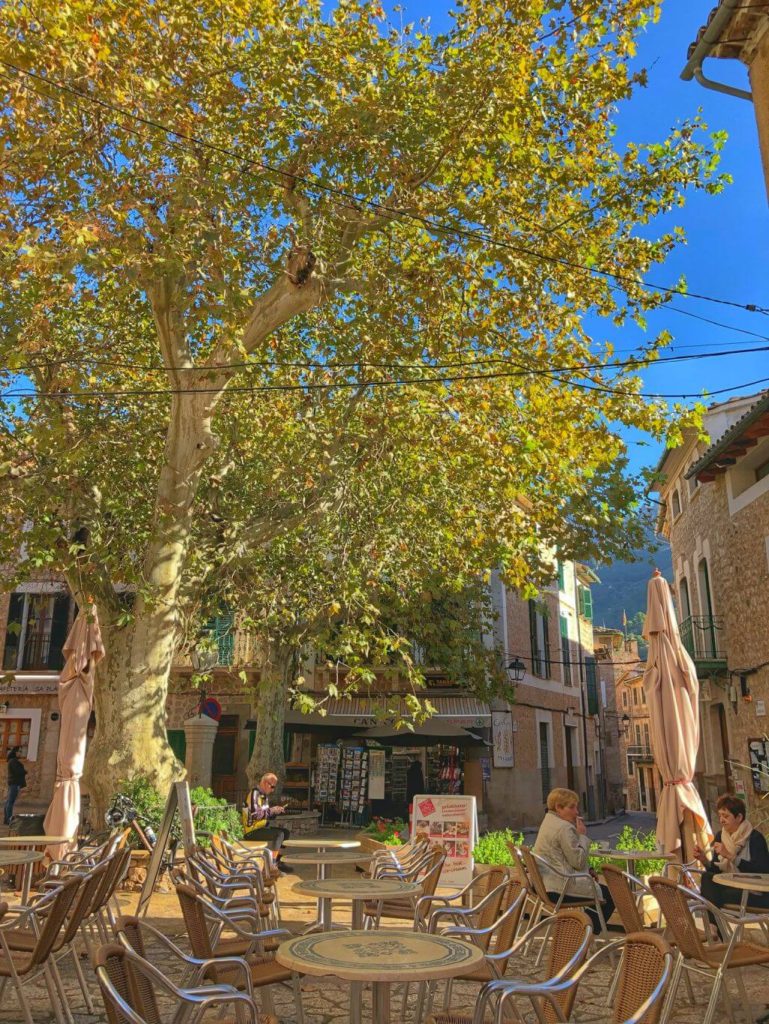
For such a small village, there’s plenty of choice. We usually go to Ca N’Antuna when we fancy Mallorcan cooking. It’s worth booking if you plan to eat there. For a more casual stop, the bars around the square are a good place for pa amb oli or a variado, a plate of assorted small dishes. You’ll often see cyclists taking a break here before carrying on through the Tramuntana.
If we’re in the mood for a sit-down meal, we look for dishes like porcella, roast suckling pig, or arròs brut, a spiced rice dish. If there’s a table on a terrace with a view, all the better for lingering after lunch.
From Fornalutx to Sóller via the Camí de Binibassí
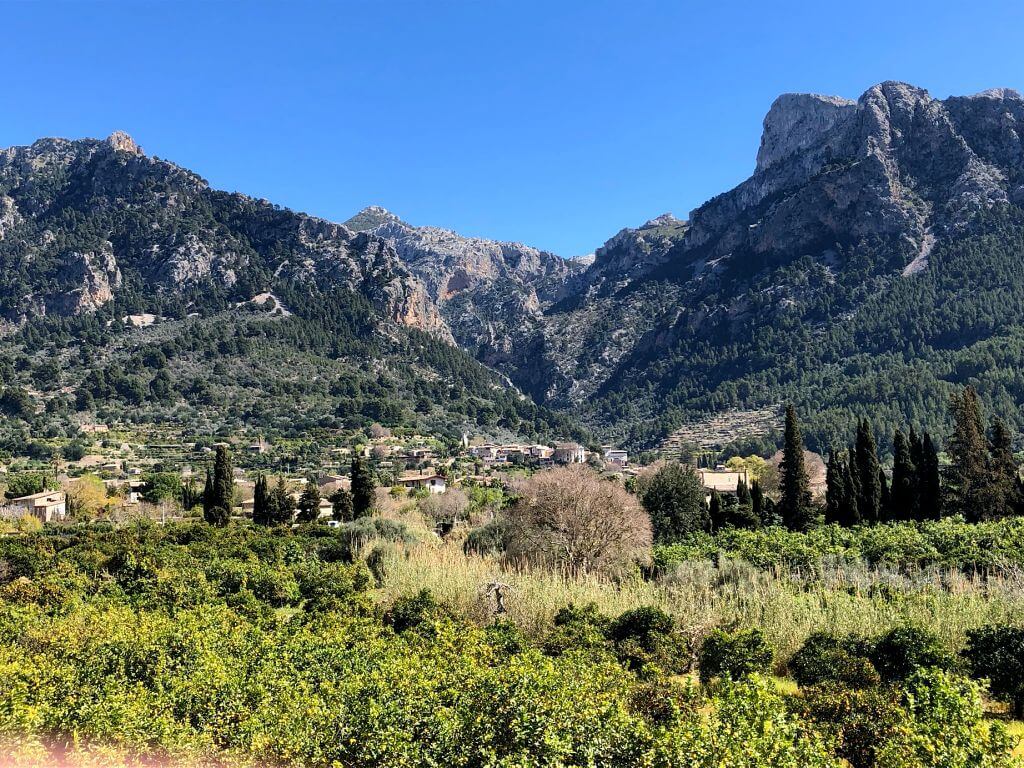
To extend the walk, we can start at Fornalutx cemetery and follow the signs for Binibassí and Sóller. Allow around 45–50 minutes one way, depending on your pace and stops. For a loop back to Fornalutx by a different route, see our circular walk via Binibassí and Biniaraix (in Spanish).
The path passes through the little hamlet of Binibassí, which began as a farmstead. It’s a good way to get to know the valley on foot with children who are used to walking. We can walk one way and take the TIB 232 bus back from Sóller. If we fancy a longer walk, the loop via Biniaraix gives us a different way back.
How to get to Fornalutx
If you’re driving, there is regulated parking at the entrances to the village. You can also take the TIB 232 bus, which connects Fornalutx with Sóller and Port de Sóller.
You might also like