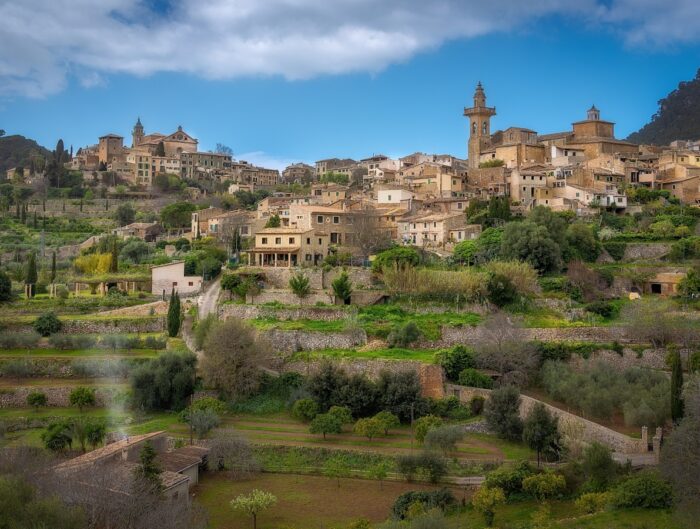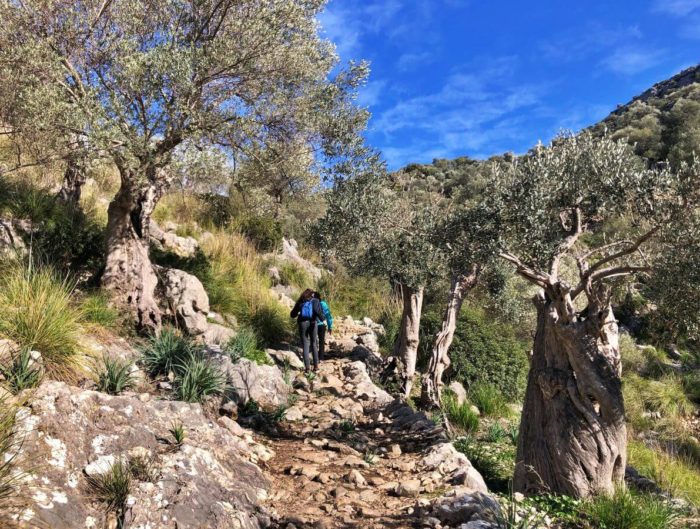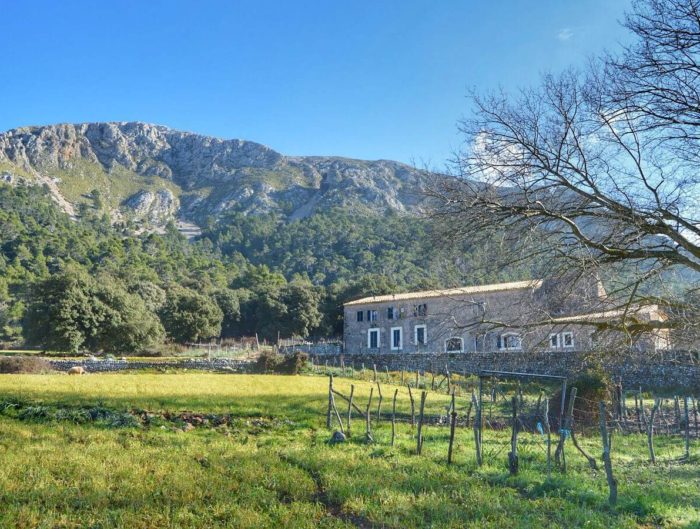

An unusual tower, a short path and beautiful coastal views. Puig de sa Moneda viewpoint, also called Puig de la Moneda, is one of those small places near Valldemossa that are easy to overlook and rewarding to discover.
It stands in the George Sand residential area, a few kilometres from the village. The plan is simple: reach Carrer de la Torre, then make a short climb on foot. This is not a long hike, although the final approach is sloping and stony. It is an interesting extra stop while exploring the area.
Getting to Puig de sa Moneda viewpoint

Leave Valldemossa towards the Ma-10, following signs for Banyalbufar and Andratx. Leave the turn to Deià on your right and continue along the main road. Further along, pass the right-hand turn down to Port de Valldemossa, another place we enjoy throughout the year.
Shortly afterwards, turn right into the George Sand residential area, then take the first street on the right, Carrer de la Torre. After a gentle rise, the tower comes into view, with a small parking area below it. Park only where allowed, without blocking driveways or entrances to homes.
From here, climb about 300 metres along a stone-paved path to the viewpoint. This is the short approach described in our guide, rather than a longer walk through the residential area or surrounding countryside. There are slopes, stones and some steps: wear shoes with grip and choose a baby carrier rather than a pushchair.
At the top, views open across the Tramuntana landscape and out to sea. In clear conditions you can pick out Sa Foradada along the coastline. Enjoy the viewpoint from outside and return along the same path.
The Archduke’s tower, inspired by Tunisia
Despite its appearance, this is neither a medieval defensive tower nor a surviving building from Mallorca’s Islamic period. It is a Moorish Revival viewpoint commissioned by Archduke Ludwig Salvator of Austria, who bought and reshaped numerous estates between Valldemossa and Deià.
Valldemossa’s municipal heritage catalogue records the tower in 1909 and attributes it to Guillem Fiol, also known as Guillem Fiol Gelabert. Its inspiration was a minaret of the Great Mosque of Kairouan in Tunisia. The exact construction date has not been established with certainty.

Look for the horseshoe-arched entrance, paired openings on the upper storey and decorative cresting. Stonework, geometric shapes and an elevated position give the building its distinctive silhouette. It stands on a dry-stone platform.
The interior entrance is closed by an iron gate. Do not plan on going inside or climbing to the tower’s terrace. The views are already rewarding from outdoors. Keep children away from edges and do not climb walls, particularly in windy weather.
Traces of a prehistoric landscape
There is more to the area than the tower. Around Son Ferrandell and Son Olesa —also written Son Oleza— prehistoric remains survive from the Naviform and Talayotic periods. Archaeological research distinguishes the George Sand stone mounds in the surrounding area from a wall recorded at the summit of Puig de sa Moneda. These are separate traces of a landscape that mattered long before the Archduke arrived.
This is not an archaeological site laid out for a museum-style visit. Observe remains from the paths, without moving stones or climbing structures. The tower and prehistoric remains belong to different periods, although they now share the same setting.
Other places to visit
The easiest combination is a walk around Valldemossa village or a visit to Port de Valldemossa. These offer different experiences: village streets in one, a small coastal landing place and old boat shelters in the other.
If you continue along the Ma-10 towards Estellencs and Andratx, Ricardo Roca viewpoint is another short stop with sea views. There is no need to fit every viewpoint into one day: these small places are best enjoyed without rushing.
Puig de sa Moneda visitor details
Frequently asked questions
Can you go inside the Puig de sa Moneda tower?
The visit described here is to the outside of the tower and the viewpoint. The interior entrance is closed by an iron gate; do not plan on climbing the tower staircase. You can enjoy the views from outside without entering.
Is it a long walk, and can you take a pushchair?
From the parking area on Carrer de la Torre, our approach is about 300 metres uphill on a stone-paved path. Slopes, stones and steps make it unsuitable for pushchairs. A baby carrier is preferable for younger children. Return along the same path.
Does the tower date from Mallorca’s Moorish period?
No. It is a Moorish Revival viewpoint commissioned by Archduke Ludwig Salvator, inspired by a minaret of the Great Mosque of Kairouan in Tunisia. The municipal heritage catalogue records it in 1909 and attributes the work to Guillem Fiol. Its appearance should not be confused with a medieval defensive tower.
Advertisement
You might also like