
Just off the road from Pollença to Lluc is a short walk that rewards a closer look. The Camí de Llinars passes a series of old watermills built one above the other on the hillside. As we climb, the view opens up across the Vall d’en Marc. After a spell of heavy rain, once the weather has settled, you may also see Salt de Llinars, a waterfall that tumbles over a reddish cliff close to the road.
The story of the Llinars watermills
The Pollença town council’s walking guide points out six mills on the way up. The Mallorca Council’s heritage inventory records seven buildings in the wider watermill complex. The mills are mentioned in records dating back to the time of Jaume I’s conquest in the 13th century, and they remained in use until 1958.
When you hear the word ‘mill’, you might picture sails. Here, it’s the stone channels to look out for. Water from the Llinars spring fed several mills in succession. The steep slope gave the falling water enough force to drive the machinery that ground the wheat. From the last mill, the water flowed on into the stream. The mills are also known as molins fariners, or flour mills. The spring that fed them is mentioned in records from 1260. According to the heritage association ARCA, it is a qanat, an underground water-collecting gallery probably built in the Islamic period.
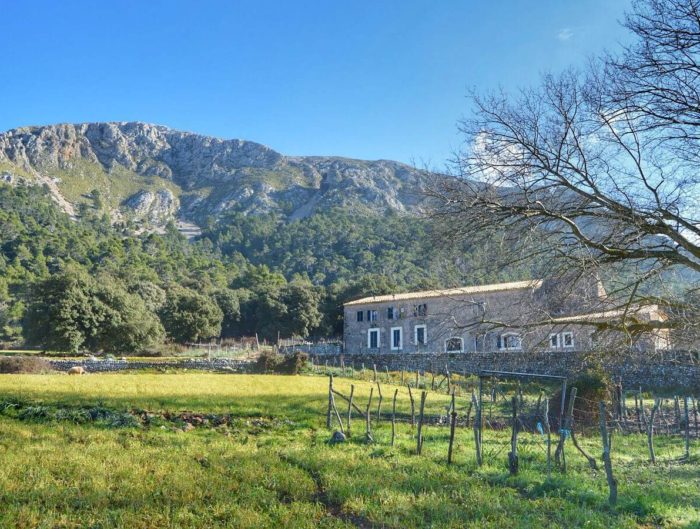
The mills are privately owned and form part of people’s homes. From the lane you can see how the buildings fit into the slope. Stay on the lane throughout the walk.
How to get to Camí de Llinars from Pollença

The council’s route starts at the former slaughterhouse, now a walkers’ refuge beside Pollença’s Pont Romà. From there, follow the Camí Vell de Lluc past the Sant Jordi and Son Marc streams and estates such as Can Guilló and Can Pontico. The turn for Camí de Llinars is signposted at the 3.6 km marker on the Ma-10, the road towards Lluc.
There is no designated parking at the turn-off. Park in a designated space in Pollença and approach on foot along the old path. Avoid stopping or parking on the roadside to see the waterfall or take photos.
The climb to the mills and Salt de Llinars
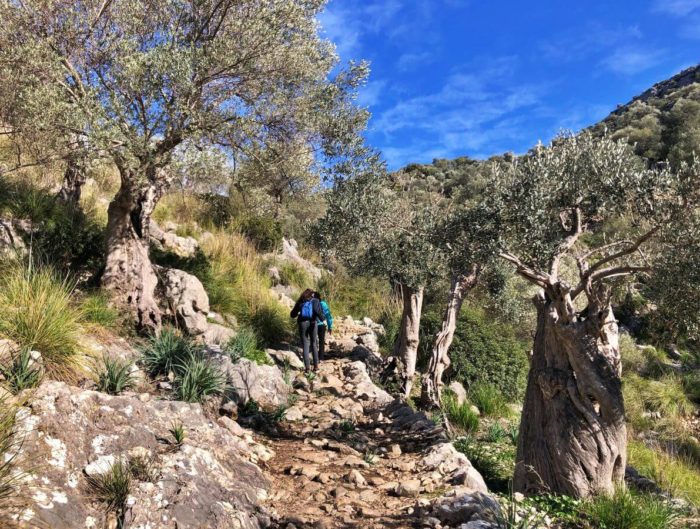
Camí de Llinars is paved and starts to climb almost straight away. Once you’ve turned into the lane and are clear of the main road, look up and a little to the right for the reddish cliff. We saw water coming over it from here. It’s some way off, but we could make it out clearly, and it’s worth pausing on the lane to look for it. The waterfall only flows when there’s been enough rain.
The mills come into view one by one as we climb, and the views over the Vall d’en Marc and towards Puig de Maria get better as we go. The last two mills are near the top of the walk. Return the same way.

Can Serra estate and the stepping stones
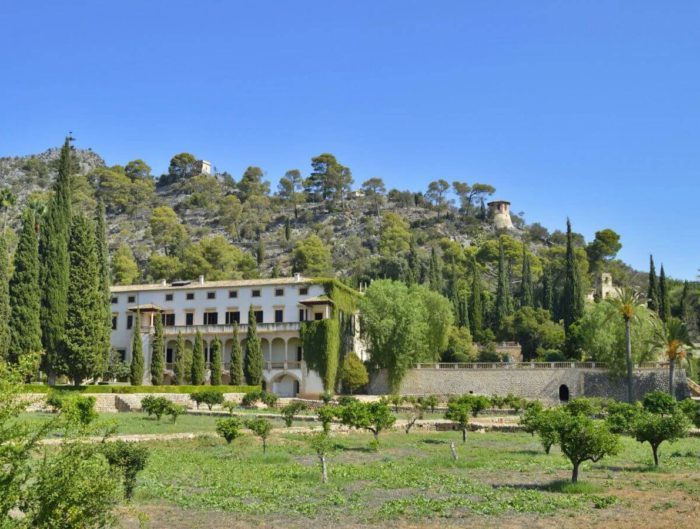
The possessió, or country estate, of Can Serra is close to the Llinars turn-off. You’ll recognise it by its red gate and the tall plane trees behind it. Opposite, on the Camí Vell de Lluc side, are the Passadores de Can Serra. These stepping stones made it possible to cross the Son Marc stream dry-footed when the water was low enough.


After enough rain, you may also see small cascades in the Son Marc stream from the path. These are separate from Salt de Llinars. If the crossing is underwater or the current is strong, turn back without trying the stepping stones. Save the walk for another day if heavy rain is continuing or a heavy rain warning is in force.

What to see in Pollença after the walk
If you still fancy a walk, the 365 steps up to El Calvari (guide in Spanish) lead to a little chapel and one of our favourite views over the town. If you’re with children, Parc dels Banys Públics has several play areas and makes a good stop before heading home.
You can see Puig de Maria from the lane by the mills. If you’d like to explore it another day, our Puig de Maria walk (in Spanish) also starts in town.
Walk at a glance
Advertisement
You might also like