
Stone houses, narrow lanes, wonderfully twisted olive trees and glimpses of the sea: Llucalcari is a tiny hamlet in Mallorca’s Serra de Tramuntana, between Deià and Sóller. What we enjoyed most on our visit was its simplicity, and the chance to slow down and look around.
This guide is based on our own walk through the hamlet and down to Es Canyeret, also known as Llucalcari beach. You can enjoy the two separately: exploring the lanes is a short outing, while reaching the cove means following a rougher path and allowing for the climb back.
What is a Mallorcan llogaret?
A llogaret is a small settlement that belongs to a larger municipality rather than having its own town council. The closest English word is hamlet. Some have a little square or a chapel, but what makes them appealing is their small scale and close connection to the surrounding countryside.
Many grew around farms dating from Mallorca’s Islamic period or around possessions, the island’s traditional country estates, although their histories vary. Some small settlements eventually became municipalities, such as Fornalutx and Ariany. Mallorca has dozens of hamlets, and Llucalcari is one of our favourites.
Our walk around Llucalcari

Llucalcari belongs to the municipality of Deià, beside the Ma-10 road towards Sóller. It is roughly two kilometres beyond the edge of Deià, or about three from its centre. Its name combines Latin and Arabic roots and is generally interpreted as “farmstead in the woods”. Another local name is Es Carrer.
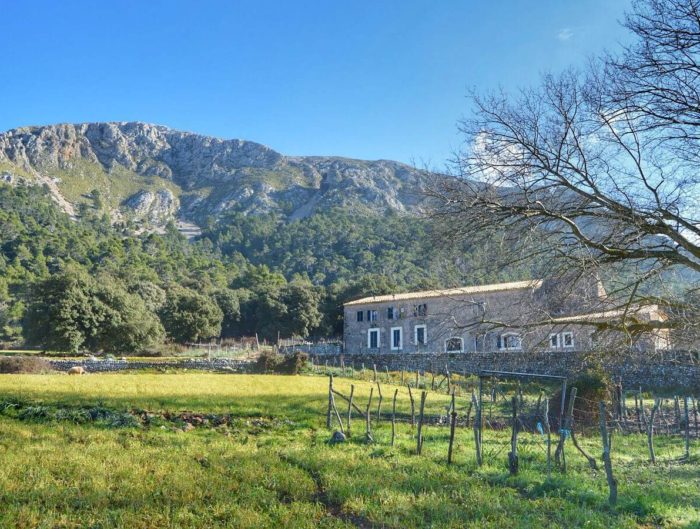
Around fifteen houses, a small oratory and a handful of lanes make up the hamlet. This is somewhere to notice stonework, shutters, plants and views between buildings, rather than work through a long sightseeing list. The oratory is associated with the local celebration on 15 August.
On our visit we found two entrances. Coming from Deià towards Sóller, the main entrance is beside the bus stop. A little further along the road, on the left, is the lovely old cobbled approach. Both lead to the main lane, with the oratory just a few steps away.
These directions help identify the entrances; they are not a suggestion to walk along the Ma-10 between them. This is a traffic-carrying mountain road, not a pedestrian promenade. Within the hamlet, respect residents’ peace and distinguish public lanes from private gardens and doorways.
Defensive towers and the Costa d’Or hotel
Llucalcari once had five defensive watchtowers, used for lookout and protection against pirate and corsair raids. Three survive: Casa d’Amunt, Can Simó and Can Apol·loni, the last also referred to as Can Paloni.
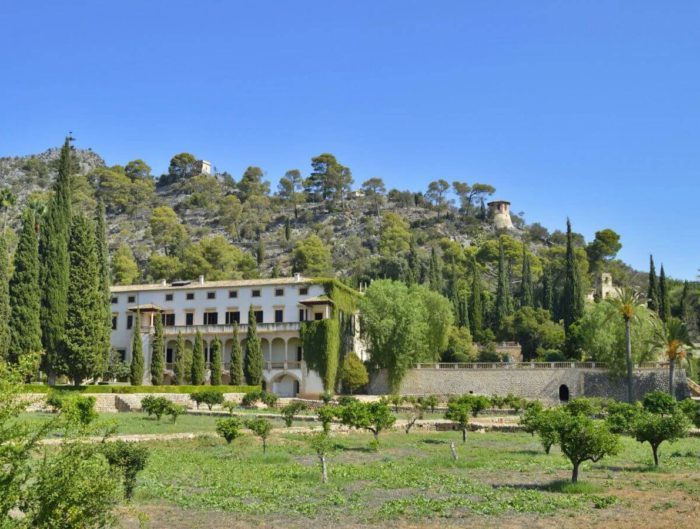
Can Apol·loni forms part of the Hoposa Costa d’Or hotel, an adults-only property. These towers belong to private properties: enjoy spotting them from the lanes, without assuming their interiors are open to visitors. The hotel’s car park is private.
There is a literary connection too: the Endrets literary geography project links Llucalcari with writing by Josep Maria Junoy and Carme Riera, whose book Epitelis tendríssims refers to the Costa d’Or.
Olive trees in the Serra de Tramuntana

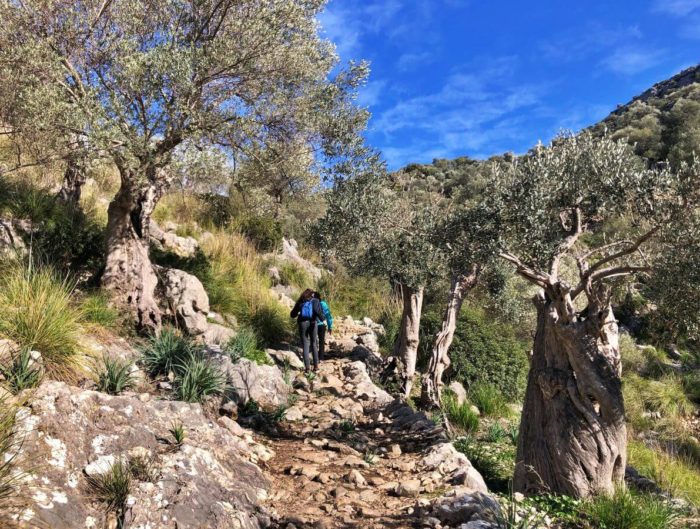
The olive groves are another highlight. Some trunks have extraordinary shapes; pausing to find faces or imaginary creatures in them is a simple way to get children looking more closely at the landscape.
Alongside almond trees, olives are one of Mallorca’s characteristic trees. Their cultivation is woven into the traditional Tramuntana landscape, where terraces and dry-stone walls made farming these slopes possible. The island’s olive oil has its own Oli de Mallorca protected designation of origin and is also sold beyond Mallorca.
Es Canyeret: Llucalcari’s rocky cove

The hamlet stands around 85 metres above sea level. A path through pine trees leads down to Es Canyeret, a small rocky and pebbly cove. On our walk we estimated the descent at roughly one kilometre and 25 minutes. Treat those as approximate figures from our visit: the starting point and your pace matter, and you still have to climb back up.
The path is not fully signposted. Near the start of our descent we passed through a metal gate that allowed access. Use the designated route, follow any signs, leave gates as you find them and do not force locked gates or cut across private grounds.
The walk down needs more care than the stroll around the hamlet. There is uneven ground and a change in elevation, so it is not a pushchair route. With children, consider their walking experience and the conditions on the day. Bring water, shoes with grip and enough time to return in daylight.
The stony shore can make entering the water awkward, particularly when there are waves. Spain’s official tourism website classifies the walking access as difficult. We would not choose it as an easy-access beach day with very young children.
Naturism is practised here. A small freshwater seep from the mountains also moistens the ground, creating patches of mud. Some bathers apply it to their skin; we mention it as a feature of the landscape, without claiming health benefits or encouraging anyone to disturb the spring and its surroundings.
Getting to Llucalcari: buses, parking and practical information
Parking is the awkward part of a visit. We saw very few roadside spaces on our walk, and you should not rely on finding one. Parking is regulated, with areas reserved for residents: follow the signs on each stretch. Do not block entrances or stop on bends or anywhere that obstructs traffic.
A useful alternative is TIB bus 203: check the current timetable, linking Palma, Valldemossa, Deià, Llucalcari, Sóller and Port de Sóller. At Llucalcari, stop 1 is towards Palma and stop 2 towards Port de Sóller. Check service notices and any booking conditions, and plan your return journey too.
Nearby walks and places to stay
You could combine the hamlet with a visit to Deià, or save our circular walk to Cala Deià for another outing. A coastal path known as the Camí dels Pintors also links Cala Deià with the Llucalcari area. This is a different walk from the one described here, with uneven ground and coastal sections. Check signs and access conditions before setting out, particularly after storms.
Llucalcari and Es Canyeret are not designated campsites. For camping options, see our guide to camping in Mallorca. Another option in the area is Refugi de Can Boi in Deià, a walkers’ refuge that requires advance booking. You will find it in our guide to Mallorca’s mountain huts and budget accommodation.
Frequently asked questions about Llucalcari
Can you camp in Llucalcari?
No. Wild camping is not permitted in Llucalcari or at Es Canyeret. Seeing other people pitching tents or spending the night does not mean it is allowed. In this protected area, camping, bivouacking and sleeping outdoors require prior authorisation; doing so without it can lead to a fine. Unauthorised camping in the area has led to enforcement action. To stay in a tent, choose a designated campsite and check its booking conditions.
Find designated campsites in Mallorca.
Can you get to Llucalcari without a car?
Yes. TIB bus 203 stops at Llucalcari and connects with Deià, Sóller, Port de Sóller, Valldemossa and Palma. Check the current timetable and service notices, and plan your return journey.
Can you visit Llucalcari with children and a pushchair?
The hamlet is small, but cobbles and slopes make a pushchair awkward. The uneven path down to Es Canyeret is not suitable for pushchairs; with children, assess their walking experience before attempting the descent and uphill return.
Is Llucalcari beach sandy?
No. Es Canyeret is a rocky and pebbly cove reached on foot. The path requires care and you need to allow for the climb back. It is not an easy-access beach for very young children.
A grapevine above a lane, a wonderfully shaped olive tree or a glimpse of sea between stone houses: these small details were the best part of our walk. They are what makes Llucalcari such a memorable corner of Mallorca.
Advertisement
You might also like